This morning, we did our second round of monitoring marine mammals from our kayaks and collecting that data to contribute to long-term science research. For both days, we saw 1 harbor seal and about 55 sea lions. You guys did a great job in a previous post identifying the pinniped species as sea lions on the buoy. This time, we saw some really interesting behavior from the sea lions.
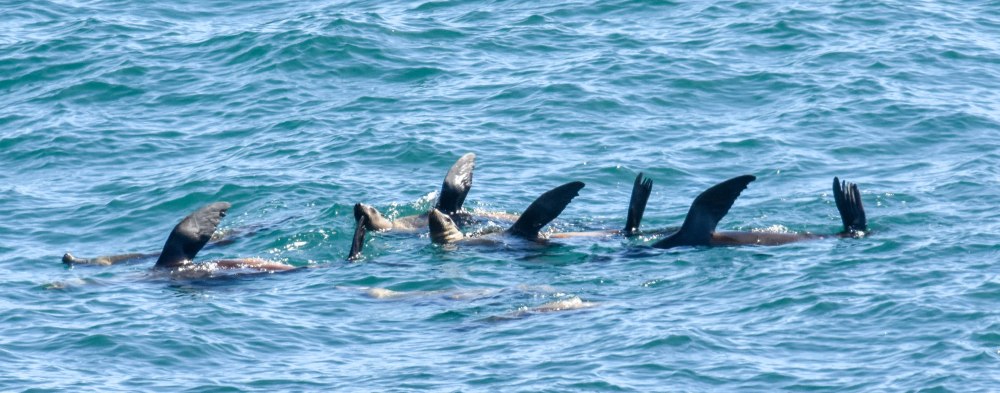
This is called rafting–any ideas about why they might be doing this?
Just saying hello, perhaps?
When the sea lions raft, it can make it difficult to count, but as our lead instructor, marine expert, and hall-of-fame diver, Lorraine, told us, “count them all and divide by 2!”.
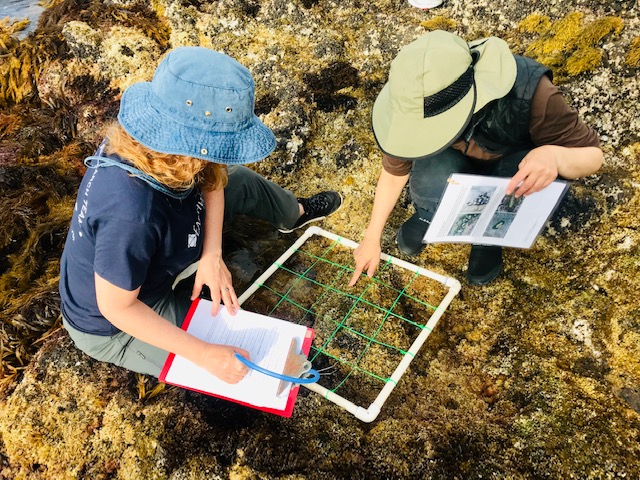
Just off the shore from where we kayaked, we did our 2nd intertidal survey. This is me and fellow Earthwatcher Joanie in the mid-tidal zone. We use that square quadrat in the picture to help us count the number of organisms in each of the small squares to determine species abundance in each tidal zone. Although we didn’t find too much in the mid-tidal, guess what?? Later on, I found a sea star! I was the only one in the entire group to find one.
In what zone do you think I found it–low tide or high tide?


Above are my pictures from our finds, including the Variable Sea Star, which is only found in the Pacific–between California and the Galapagos Islands. I’m going to let you identify the rest. I will tell you that one of them is a gooseneck barnacle–which people once thought is where geese came from. This is why we say, “Thank you, Science!”
We’ve done so many things on this expedition, I wasn’t able to cover it all here. We did a bioluminescent snorkel, which was phenomenally breathtaking, learned from a local how to do sustainable spear fishing, talked to graduate students about the environmental science research they are doing to ultimately help and heal the planet, and did a whole bunch of data collection on planktonic organisms, which are important indicators of harmful algae blooms or HABs. We all got really good at looking in microscopes and identifying all kinds of interesting, alien-looking, microscopic life forms. These are the same life forms that lit up through bioluminescence during our night snorkel! I have a newfound appreciation for all of the wonders of our ocean and for everyone who is trying to protect it.
Please do each of the following:
1.) Answer the 2 questions highlighted in bold in this post.
2.) Identify the rocky intertidal organisms that I saw today using the field guide.
3.) Considering all of the posts from the field and topics that I have mentioned, which topic are you most interested in learning more about?

 Conserving Marine Life on Catalina's Coast
By the ocean
LikeLike
I would like to learn more about the ecosystems in California and how they work.
LikeLike
Octopus, Seaweed, water snake, see star
LikeLike
They might be relaxing in the sun? You probably found the seastars in high tide.
1- Seastar
2-Dead man’s fingers?
3-chitons?
4-Aggregating Anemones?
5-Leaf barnacle?
LikeLike
1. They are sleeping and keeping their fins up to keep them warm!
2. I think you found this at low tide
LikeLike
1. I think the seals raft to regulate their body temperature.
I think you found the sea star at low tide, because at high tide, I think it would’ve been hard to see the star fish under lots of water.
2. The first one is a Variable sea star, the second one is Dead Man’s Fingers, the third one is a Chiton, the fourth one is a Aggregating Anemones, and the fifth one is a gooseneck barnacle.
3. I am most interested in learning more about how people identify and find new species.
LikeLike
1.) Answer the 2 questions highlighted in bold in this post.
a. Sea lions raft to regulate their body temperatures
b. I think you found the sea star at low tide.
2.) Identify the rocky intertidal organisms that I saw today using the field guide.
Dead Mans fingers
Chitons
Starfish
Aggregating Enenomes
Gooseneck Barnacle
3.) Considering all of the posts from the field and topics that I have mentioned, which topic are you most interested in learning more about?
I’m really interested in tide pools.
LikeLike
Answer the 2 questions highlighted in bold in this post:
1. I believe that the sea lions are rafting because they are either sleeping or defending themselves from predators
2. I believe that this was found in low tide. I believe this because if this was found in high tide, the creature would’ve been covered.
Identify the rocky intertidal organisms that I saw today using the field guide:
1. gooseneck Barnicle
2. sea star
3. aggregating anemone
4. Chiton
5 dead man’s finger
Considering all of the posts from the field and topics that I have mentioned, which topic are you most interested in learning more about:
1. Island dwarfism/giantism
2. how the Catalina Island foxes are doing now
LikeLike
1. I think that the sea lions raft in order to regulate their temperature. Also, they could raft in order to see what predators might be around.
I think you found the sea stars in low-tide because, in low-tide, sea stars would still be able to be submerged by water.
2. The first one is a Variable Sea Star, the second one is dead man’s fingers, the third one is a chiton, the fourth one is aggregating anemones, the last one is gooseneck barnacle.
3. I am most interested in learning about different organisms that live in the water and whether or not they live in low-tide or high-tide and why. I am also interested in animal giantism and dwarfism.
LikeLike
This is called rafting–any ideas about why they might be doing this?
They are regulating their body temperature.
In what zone do you think I found it–low tide or high tide?
low tide because it would be easier to spot a sea star with less covering it.
Identify the rocky intertidal organisms that I saw today using the field guide.
1. Sea Star
2. coral
3. chitons
4. sea slug
5. goose neck barnacles
Considering all of the posts from the field and topics that I have mentioned, which topic are you most interested in learning more about?
How Island animals vary sizes based off of their locations, animal dwarfism and giantism
LikeLike
1) Sea lions raft in groups to sleep safely, and the flipper sticking out of the water is so the sea lions can regulate their body temperature as they sleep. I also think the starfish you found was in the low tide.
2)
1. Seastar
2. Coral
3. Chitons
4. Sea slug
5. Gooseneck barnacle
3) I am most interested in marine biology and preservation, dwarfism vs giantism, and how to identify a new species.
LikeLike
Rafting means that they are regulating their body temperature.
I think it was low-tide when you found the sea star because it would be under water.
1. Sea star
2. Dead man’s fingers
3. Chitons
4. aggregating anemones.
5. Gooseneck barnacle
Something that I would like to learn more about is giantism and dwarfism.
LikeLike
1. I believe rafting is when sea lions come up for air together
2. I think you found the sea star in low tide
3.
– a starfish
– a dead man’s finger
– chiton
– an aggregating anemones
– a left barnacle
4. I’m interested in learning more about dwarfism and giantism
LikeLike
I think that rafting is when they put up their flippers in the sunlight so then it gets warmer. I think that you found it in the low tide. The 1st picture is a sea star. The 2nd picture is a Dead Man’s finger. The 3rd picture is a chiton. The 4th picture is Aggregating Anemones and the 5th picture is a gooseneck barnacle. I like this post the best.
LikeLike
Rafting is a term for sea lions when they keep their tail or fin exposed in the air to regulate their body temperature. Sometimes their nose will pop up so they can breathe (the rest of their body is in the water).
I think you found the sea star in low tide.
– Variable Sea Star
– Dead Man’s Fingers
– Chiton
– Aggregating Anemones
– Leaf Barnacle
From the blog post and skype call, I am most interested with the harmful algae blooms, I have some knowledge about it, but I know that algae use oxygen and that can cause deoxygenated water, killing all living orgasms living within it. Algae can also be toxic.
LikeLike
1.) Answer the 2 questions highlighted in bold in this post.
This is called rafting–any ideas about why they might be doing this?
They might be doing this to regulate body their body heat by heating themselves up in the sun.
In what zone do you think I found it–low tide or high tide?
I think that you found it in low tide.
2.) Identify the rocky intertidal organisms that I saw today using the field guide.
You saw a…
1. Variable Sea Star
2. Dead Man’s Fingers
3. Chiton
4. Aggregating Anemones
5. Gooseneck Barnacle
3.) Considering all of the posts from the field and topics that I have mentioned, which topic are you most interested in learning more about?
I am the most interested in learning about what we as humans can do to prevent things like the sewer leakage that happened in Los Angeles. I am also interested in the dwarf and giant animals on Catalina Island, as well as other islands.
LikeLike
1.) Answer the 2 questions highlighted in bold in this post.
This is called rafting–any ideas about why they might be doing this?
Sea lions lift their flippers and tails out of the cold ocean water and into the sunlight to regulate their body temperatures while they sleep. They sleep in groups also to warm them (as any mammal would huddle together for warmth/to share body warmth.
In what zone do you think I found it–low tide or high tide?
Sea stars are almost always found in low tidal areas. If you went to the touch tank of an aquarium, you almost always find sea stars in the (nearly) stillwater tanks.
2.) Identify the rocky intertidal organisms that I saw today using the field guide.
1. Variable Sea Star
2. Dead Man’s Fingers
3. Chiton
4. Sea Slug
5. Gooseneck Barnacle
3.) Considering all of the posts from the field and topics that I have mentioned, which topic are you most interested in learning more about?
I think I’d be most interested in learning about island gigantism.
LikeLike