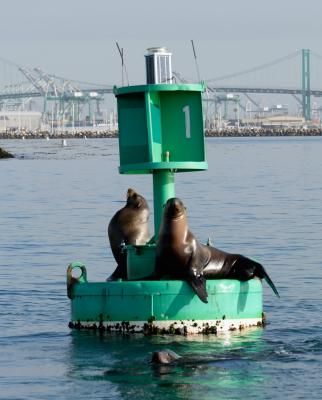
Yesterday, we traveled out to Catalina Island from Long Beach with an eventful ferry boat ride with our research team. We had a naturalist, Jill, with us who specializes in whales, cetaceans (dolphins), and pinnipeds, and helped everyone identify the marine mammals that we saw along the way. As we left the pier, we saw some pinnipeds chilling out on a buoy. Can you tell what species of pinniped they are?
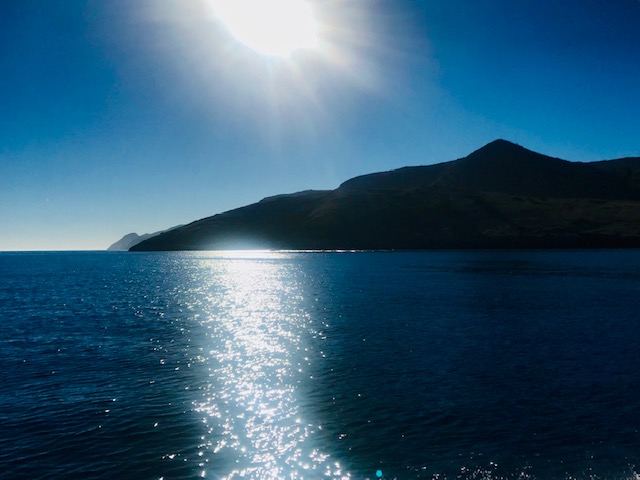
Later, when we reached the open water, we spotted several pods of Pacific White-Sided Dolphins before Catalina started coming into view.
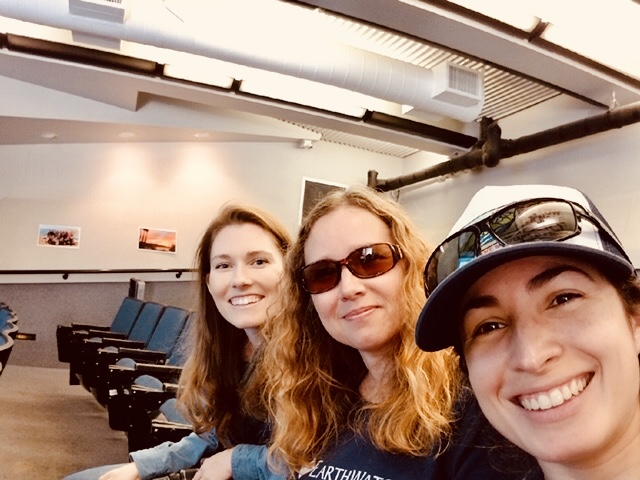
Our afternoon focused on getting familiar with where will be staying on the island, which is a research station called USC’s Wrigley Institute for Environmental Studies. We’re here with many groups of scientists, and graduate students who are doing all kinds of different marine science research to help protect this area and the California coast. Our naturalist, Jill, also spent some time with us on the island giving a fun and informative talk on pinnipeds. Here I am with some of the other teacher fellows in our group (also from the Bay Area) before the presentation.
One of the most interesting things I heard from the talk was that pinnipeds cannot chew their food like we do, and so they have to do something called “thresh” their prey, which makes it look like they are playing with their food. Threshing is when they hold prey with their very large front and back canine teeth and shake their heads back and forth, to break it up into smaller pieces. You may have seen one do this in a youtube video that went kinda viral recently:
What looks like a sea lion attacking a kayaker with an octopus, is actually a sea lion (not a seal like it says!) just trying to eat it’s lunch.
Lucky kayaker or unlucky?
Answer the following questions below:
- So, what species of pinniped is that on the buoy that we saw? How do you know?
- We also learned that unlike us, pinnipeds have to provide their own thermoregulation–what do you think thermoregulation means (do a quick search if you need to) and how do you think the pinniped in my first picture is thermoregulating?

 Conserving Marine Life on Catalina's Coast
I think it is a Californian Sea Lion because of its large front flippers. And it’s also located in the coast of California.
LikeLike
1. I think it is a Sea Lion because they are near California and a lot of them are by California
2. Thermoregulation is how you regulate your temperature.
LikeLike
The first animal is a California Sea Lion because of its large body and flippers. I can tell that it is not a seal because I can identify different types of seals.
Thermoregulation is a process that allows a mammals body to maintain its inner temperature.
LikeLike
1) The pinniped is a sea lion since they tend to be around California, and you are off the coast of CA, and they have similar characteristics to ones I’ve seen before.
2) I think thermoregulation has to do with keeping your body at the right temperature, I can be wrong.
LikeLike
1. I believe that it’s some type of sea lion because they look very familiar.
2. It looks like the sea lions/ pinniped is using the sun to thermoregulate.
LikeLike
1. California Sea Lion because it is darker and the Catalinas are on the coast of California.
2. Thermoregulation is regulating your inner body temperature. They are doing this by clumping together to warm up.
LikeLike
these are beautiful islands cathy! i would love to learn more!
LikeLike
I believe that the species of pinniped on the buoy is a sea lion. My reasoning for this is that sea lions ear flaps are visible while seals lack visible ear flaps.
Pinnipeds rely on thermalregulation. Thermalregulation is the process when your body maintains the core internal temperature. Thermalregulation works to attain homeostasis. In the photo of the pinnipeds on a buoy, they are using the heat from the sun to increase their body temperature and achieve homeostasis.
LikeLike
1) The specie of pinniped that was on the buoy they saw was a Sea Lion. I know this because they look similar, and Sea Lions are commonly off the coast of California.
2) Thermoregulating means maintaining your core internal temperature, which the pinnipeds have to provide for themselves. I think the pinniped in the first picture are themoregulating from there blubber.
LikeLike
The species is a sea lion and Thermoregulating means to maintain inner heat which pinnipeds always do
LikeLike
1) I think that the pinniped you saw was a sea lion because they are known to be around California and look kinda like them.
2) Thermoregulating is when something keeps its internal temperature by compacting it with lots of layers. for example, seals have blubber.
LikeLike
they are sea lions and Thermoregulatingeans to maintain heat
LikeLike